
Raw materials
Resins, plaster, carbon and thermoplastics: the consumables a workshop burns through with every single socket it makes.
Open the Gait works in partnership with the Syrian American Medical Society. The arrangement is deliberate: it lets a small, focused team raise funds for prosthetic care and physiotherapy without duplicating clinical infrastructure that already exists and already works.
The Syrian American Medical Society is a global medical relief organization working on the frontlines of crisis response in Syria and beyond. Founded in 1998 by Syrian-American physicians, SAMS supports more than 50 healthcare facilities and is led by the people it serves.
The partnership is a straight division of labor. SAMS brings the infrastructure: the clinicians, the facilities, the procurement and a permanent presence on the ground. Open the Gait brings one narrow focus that sits outside their existing programs, prosthetic care and physiotherapy, and the fundraising to pay for it.
The formal term for the arrangement is fiscal sponsorship: SAMS holds and governs the funds, and we operate as a project under them. What it means in practice is that your donation enters an established organization on day one, and a small team can put its whole effort into raising money for limbs and rehabilitation instead of building a back office.
It also means your gift is tax-deductible. The Syrian American Medical Society (SAMS) Foundation is a registered 501(c)(3) nonprofit, so donations are deductible in the United States to the full extent allowed by law, and your receipt comes from the SAMS Foundation rather than from us.
Our partner organization
Syrian American Medical Society (SAMS) Foundation
Nothing about this chain is complicated. It is simply underfunded, which is exactly why a small foundation can make a measurable difference in it.
Individual donations, recurring gifts and campaigns are pooled into a single fund dedicated to prosthetic care and physiotherapy. We do not spread ourselves across unrelated causes.
Funds sit with SAMS, which provides the financial governance and confirms that money raised for prosthetic care is spent on prosthetic care.
The money buys the physical inputs care depends on: raw materials for fabricating sockets and limbs, prosthetic components, and the therapy equipment used in rehabilitation.
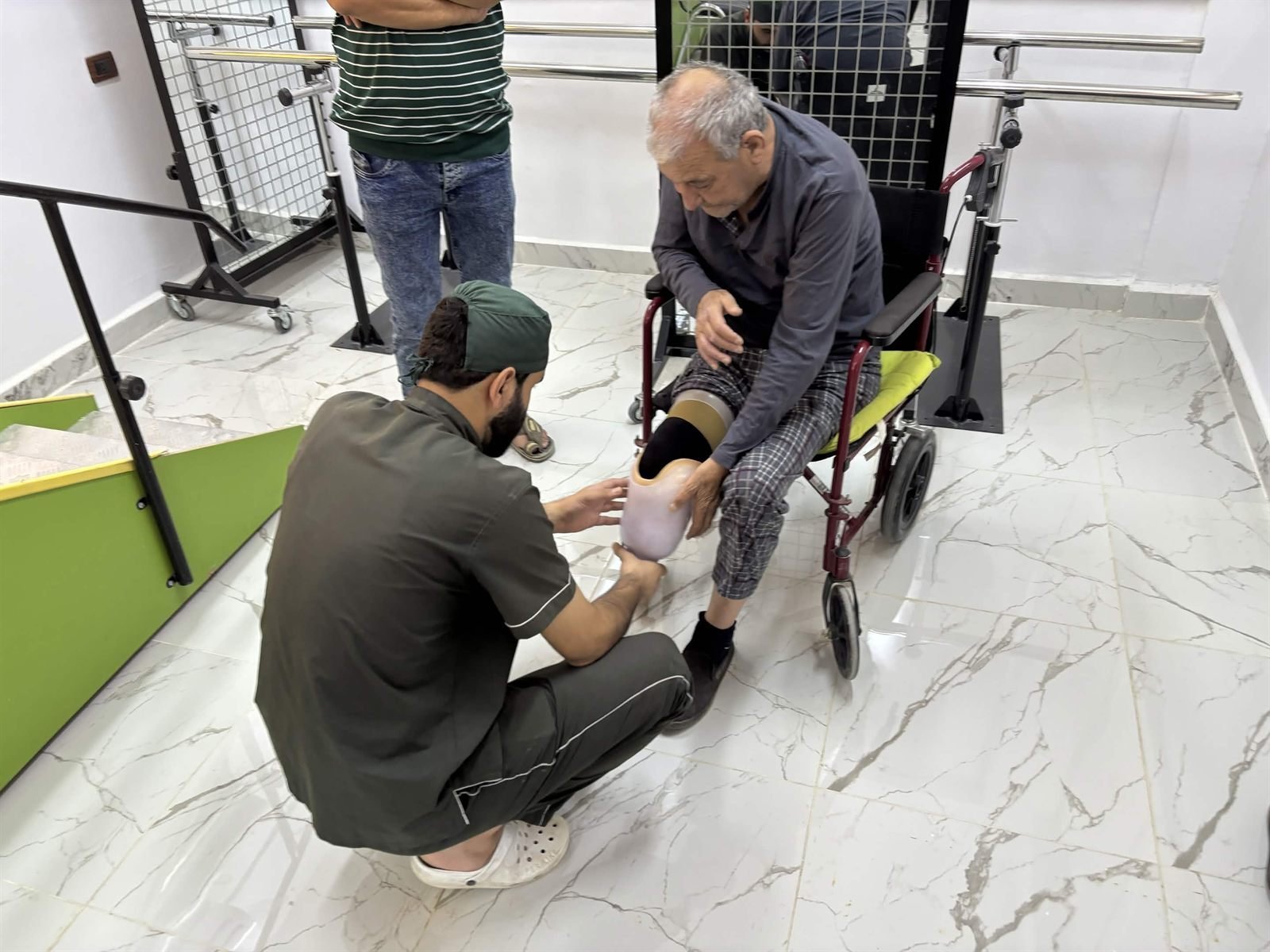
Supplies are transported to the prosthetics center, where trained clinicians cast, fabricate and fit limbs, and run the physiotherapy that teaches people to use them.
Prosthetic care fails at the supply end far more often than the clinical end. These are the inputs that run out.
Resins, plaster, carbon and thermoplastics: the consumables a workshop burns through with every single socket it makes.
Feet, knees, pylons, liners and fastenings: the engineered parts that cannot be improvised locally and have to be bought in.
Parallel bars, gait trainers and rehabilitation aids. Without them, a well-fitted limb frequently ends up unused in a cupboard.